
Introduction
In recent years, concerns about personal data privacy have shifted from niche technical forums into mainstream public discourse. Today, billions of individuals interact with online services that collect, process, and sometimes trade their personal information. Government records, social media profiles, marketing databases, and data brokers all contribute to a landscape in which personal details can be widely accessible—often without an individual’s explicit awareness. As this landscape has expanded, so too has interest in solutions designed to help individuals understand where their information resides online and what can be done to reduce unwanted exposure.
The term “data broker” refers to companies that collect personal Optery information from a variety of sources, aggregate it, and then redistribute it to third parties. These aggregated profiles might contain names, addresses, phone numbers, email addresses, family members, employment history, and other identifiers. While some of this data may be used for benign purposes such as consumer analytics, much of it is also used for targeted advertising, background checks, and other commercial activities that individuals might prefer to control or limit. For consumers interested in privacy management, tools that automate or simplify processes of discovery and removal are increasingly important. It is in this context that Optery has emerged—offering a structured system intended to help users locate and opt out of data broker listings.
What Is Optery?
Optery is a technology platform in the personal data privacy category designed to help individuals identify and remove their personal information from online databases. In essence, the product performs searches across public and commercial databases to determine where a user’s personal data appears, and then navigates opt‑out procedures—either automatically or with guided support—to request removal from those sites.
Optery does not sell personal data, nor does it promise the complete disappearance of an individual from the internet. Instead, it provides visibility into the digital footprint and offers systematic pathways to reduce visibility where legal and practical mechanisms allow. In classification terms, Optery belongs to the broader domain of privacy management, data control software, and digital footprint reduction services.
Key Features Explained
To understand Optery’s role and capabilities, it is useful to break down its key features:
Exposure Reporting
At the core of Optery’s functionality is exposure reporting. This involves scanning a wide range of online sources—especially data brokers—to locate instances of a user’s personal information. These reports typically list the sites where data is found, along with the specific elements discovered (such as name, address, or phone number). The goal of exposure reporting is to make the invisible visible; many users are unaware of how widely their personal details have proliferated across data broker networks.
Automated Removal Requests
Once exposure is identified, Optery assists with or automates the process of submitting removal requests. Data brokers often require users to complete opt‑out forms, provide identification, or navigate complex verification steps. Optery can handle many of these actions on behalf of the user, submitting forms and tracking progress without the user having to replicate the process manually for each site.
Removal Verification Documentation
A distinguishing feature of Optery is the provision of verification documentation. After a removal request is processed—whether automatically or with user input—the platform provides documentation such as screenshots or status notes. This creates an audit trail that users can reference, improving transparency and helping to confirm that steps were taken.
Custom Removal Assistance
Not all data sites operate with standardized opt‑out forms or automated solutions. For listings that require more nuanced interaction, Optery provides custom removal options. This may involve copy‑and‑paste templates, guided instructions, and additional support resources to ensure that even non‑standard requests can be managed effectively.
Family and Multi‑Profile Support
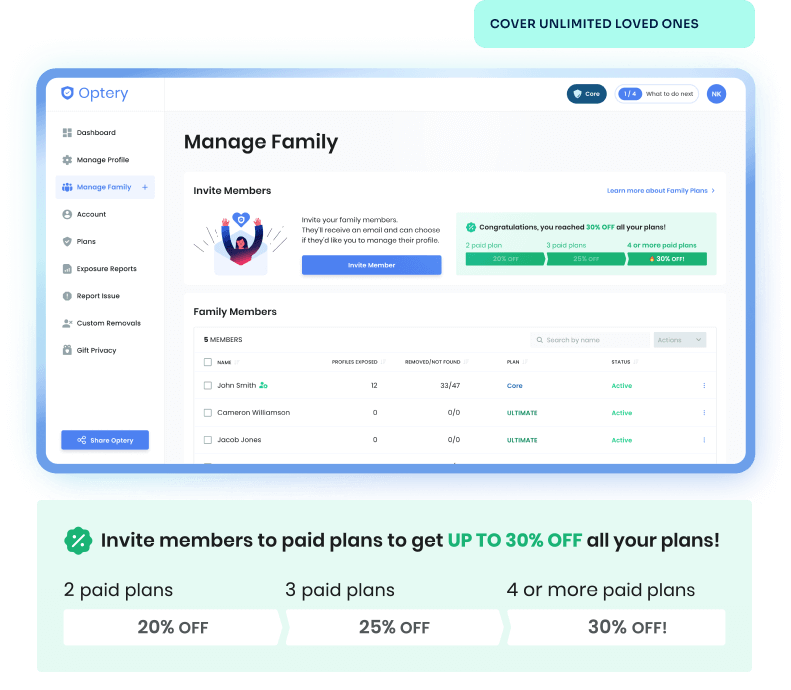
Recognizing that privacy concerns often extend beyond a single individual, Optery offers plans that allow management of multiple profiles under one account. This is particularly relevant for families or organizations seeking to oversee the digital footprints of several individuals.
Security and Compliance Standards
Data privacy tools inherently handle sensitive personal information, and Optery is designed with security in mind. The platform adheres to recognized compliance frameworks such as SOC 2 Type II, which indicates an emphasis on secure data handling, access controls, and operational governance.
Common Use Cases
Understanding the real‑world scenarios in which Optery is applied can clarify its relevance:
Individuals Seeking to Reduce Online Exposure
For many people, the primary motivation behind using Optery is the desire to limit the number of places where their personal information is publicly accessible. This may be motivated by concerns about identity theft, unsolicited contact, or general privacy preferences.
Prevention of Identity Fraud
Identity theft remains a significant issue globally. Personal information published on data broker sites can be scraped by malicious actors to support fraudulent applications, account takeovers, or social engineering attacks. By reducing the visibility of sensitive data, Optery aims to limit the pool of easily accessible personal information that fraudsters might exploit.
Digital Privacy Audits
Some users approach Optery as part of a broader privacy audit. By cataloging where information appears, individuals and privacy-conscious professionals can build an understanding of their digital footprint, potentially leading to further action such as tightening social media settings or reevaluating third‑party service usage.
Professional and Sensitive Roles
Certain occupations—such as journalists, lawyers, activists, and executives—may require heightened privacy measures due to personal or professional risk profiles. For these users, the ability to monitor and control online exposure can be a practical component of risk management.
Potential Advantages
Optery offers several potential benefits for users navigating the complex ecosystem of online data:
Reduced Manual Effort
Without tools like Optery, users must manually locate and visit each data broker website to submit opt‑out requests—an effort that can be time‑consuming and technically complex. Optery automates or streamlines many of these steps.
Enhanced Visibility
The exposure report provides a centralized view of data presence across multiple third parties. This kind of comprehensive mapping is difficult to achieve through manual search alone, particularly given the number of smaller or less well‑known data broker sites.
Structured Documentation
The inclusion of removal verification materials helps users understand what actions were taken and provides a reference record of those actions. This transparency can be useful for personal record‑keeping or for future follow‑up if necessary.
Scalability for Multiple Profiles
Managing data exposure for multiple individuals—such as family members—can be especially challenging. Optery’s support for multi‑profile management centralizes these efforts, which may be beneficial for households or small organizations.
Security‑Focused Practices
Optery’s compliance with recognized security standards suggests a focus on protecting the sensitive information it processes. For users wary of entrusting their personal data to a privacy management tool, this institutional commitment can provide reassurance.
Limitations & Considerations
Despite its structured approach, Optery has limitations that users should consider:
Incomplete Coverage
Not all data brokers or information repositories may be indexed or accessible by Optery’s scanning mechanisms. Some sites may not be covered due to technical barriers, lack of cooperation with automated opt‑out processes, or continuous changes in listing patterns.
Legal and Jurisdictional Variation
Privacy laws vary significantly across countries and regions. Some jurisdictions—such as the European Union under GDPR—mandate stronger rights to access and deletion than others. Optery’s effectiveness may vary depending on local regulations and the legal obligations of the sites in question.
Dependence on Accurate Input
The accuracy of exposure reports and removal success depends on the information provided by the user. Incorrect spellings, outdated contact details, or incomplete records can limit the detection and removal process.
Ongoing Monitoring Requirements
Data brokers often repopulate databases with new information over time. A single removal effort may not guarantee long‑term absence of personal data. Continued monitoring and periodic removal efforts may be necessary to maintain a reduced digital footprint.
Non‑Guarantee of Universal Removal
It is important to recognize that no tool can eliminate all traces of personal information from the internet. Some records—such as public government filings or legally mandated disclosures—may not be eligible for removal. Users should have realistic expectations about what digital footprint reduction can achieve.
Who Should Consider Optery
Optery may be particularly relevant for:
- Individuals who are concerned about personal information being easily discoverable online.
- Households seeking to manage the privacy of multiple family members.
- Professionals in sensitive roles or industries where personal data exposure carries risk.
- Privacy researchers and advocates examining patterns of data distribution.
- Users interested in structured documentation of data removal efforts.
Who May Want to Avoid It
Conversely, Optery may be less applicable for:
- Individuals with minimal online presence or limited data exposure.
- Users in jurisdictions where opt‑out rights are severely restricted or not recognized.
- Those who prefer manual control over every aspect of the removal process without automation.
- Individuals seeking comprehensive deletion of all personal data without regard to legal or practical boundaries.
- People uninterested in ongoing monitoring or who view digital exposure as a low priority.
Comparison With Similar Tools
Within the field of personal privacy management, Optery is not alone. Comparable tools and services exist that offer data broker scanning and removal assistance. When compared with manual opt‑out efforts, these types of tools can significantly reduce labor and complexity.
However, differences arise in scope, automation level, documentation transparency, and data source coverage. Some services may emphasize automated tracking and alerts, others may focus on attorney‑assisted removal strategies, and still others provide broader data security packages that include credit monitoring or identity theft insurance. In evaluating Optery relative to these alternatives, users should consider factors such as the breadth of data broker coverage, the extent of automated versus manual support, and the level of reporting detail provided.
Final Educational Summary
Optery exemplifies a class of tools developed in response to growing concerns about personal data privacy and the proliferation of online information. By identifying where personal details appear across data broker sites and facilitating or automating opt‑out requests, it offers users a structured method for reducing digital exposure. While the platform does not guarantee complete invisibility on the internet, it provides valuable visibility, procedural support, and documentation that can be difficult to replicate through individual manual efforts.
Understanding both the capabilities and limitations of tools like Optery is crucial for anyone seeking to navigate the modern data landscape. Such tools serve as one part of a broader strategy for digital privacy—a strategy that may also include mindful use of social platforms, careful management of account permissions, and an awareness of legal privacy rights in one’s jurisdiction.
Disclosure
This article is for educational and informational purposes only. Some links on this website may be affiliate links, but this does not influence our editorial content or evaluations.
