
Introduction
Digital communication ecosystems have evolved significantly over the past decade, shifting from isolated email campaigns to integrated, multi-channel engagement systems. Businesses operating in e-commerce and online services increasingly rely on automation platforms to manage customer communication at scale. This evolution is largely driven by the need to coordinate messaging across email, SMS, and on-site interactions without fragmenting user experience or overwhelming internal teams.
Omnichannel marketing tools exist to address this coordination challenge. As customer journeys become more nonlinear, organizations require systems that can track behavioral signals, segment audiences dynamically, and trigger communication workflows based on real-time activity. Within this broader category of marketing automation software, Omnisend is positioned as a platform designed to unify communication channels and streamline campaign management for digital businesses.
Understanding how Omnisend fits into this landscape requires examining its functional architecture, intended use cases, operational strengths, and its limitations in comparison to alternative systems. This article provides an objective breakdown of these aspects without promotional framing, focusing instead on its role as a structured marketing automation solution.
Visit Official Website
What Is Omnisend?
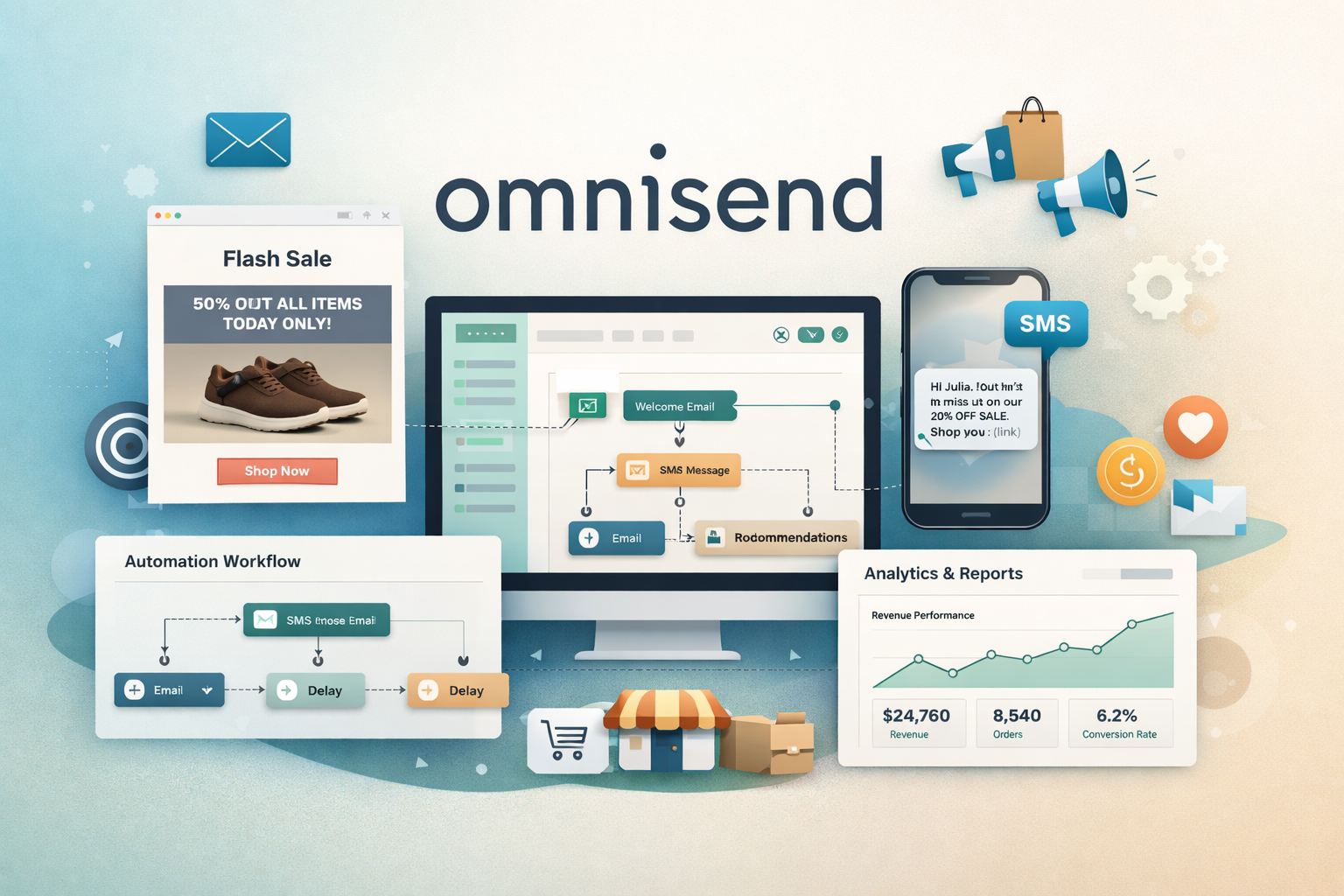
Omnisend is a cloud-based marketing automation platform primarily categorized under omnichannel communication and e-commerce marketing software. It is designed to help businesses manage customer engagement across multiple channels such as email marketing, SMS messaging, and automated behavioral workflows.
At its core, Omnisend functions as a centralized system for coordinating customer communication based on user activity data. It integrates with online storefronts and digital commerce platforms to collect behavioral signals such as browsing patterns, cart activity, purchase history, and engagement metrics. These signals are then used to construct segmented audiences and automated workflows.
From a technical standpoint, Omnisend operates as a workflow automation engine layered with customer relationship management capabilities and analytics tracking. It is often grouped within the broader categories of email marketing software, marketing automation tools, and customer lifecycle management systems.
Key Features Explained
Omnisend includes several functional modules that collectively support automated communication and campaign orchestration.
1. Omnichannel Campaign Automation
The platform enables the creation of workflows that span multiple communication channels. Instead of relying solely on email sequences, Omnisend incorporates SMS and push-style messaging into automation flows. These workflows are typically triggered by predefined user actions or behavioral conditions.
2. Segmentation and Audience Targeting
A core component of Omnisend is its segmentation engine. Users can categorize audiences based on behavioral, transactional, and demographic data. Segmentation rules can include purchase frequency, browsing activity, engagement levels, and lifecycle stage.
This system allows marketers to construct dynamic audience groups that update automatically as customer data changes.
3. Email Campaign Builder
Omnisend includes a visual editor for building structured email campaigns. This editor is designed to support modular content blocks, enabling the assembly of structured messages without requiring advanced coding knowledge.
Templates are typically organized for transactional messaging, promotional campaigns, and automated lifecycle communication.
4. Automation Workflow Builder
The workflow builder is a central functional element. It allows the construction of conditional sequences where messages are triggered based on specific user actions. These workflows may include abandoned cart recovery sequences, welcome flows, or post-purchase follow-ups.
5. Reporting and Analytics
Omnisend provides performance tracking tools that measure campaign engagement, conversion behavior, and revenue attribution. These analytics systems are used to evaluate how communication sequences contribute to user actions over time.
6. Integration Ecosystem
The platform supports integration with various e-commerce infrastructures and third-party applications. These integrations allow data synchronization between storefront activity and marketing automation workflows.
Common Use Cases
Omnisend is generally used in environments where customer lifecycle communication is essential. Its typical applications include:
- E-commerce marketing automation for online stores
- Abandoned cart recovery workflows
- Customer onboarding sequences
- Promotional campaign distribution
- Re-engagement campaigns for inactive users
- Post-purchase communication and feedback collection
- Behavioral segmentation-based messaging strategies
These use cases reflect a broader shift toward automation-driven customer engagement rather than manual campaign management.
Potential Advantages
From an operational perspective, Omnisend introduces several structural benefits within marketing systems:
Unified Communication Management
The consolidation of email and SMS workflows into a single interface reduces fragmentation across marketing channels.
Behavior-Based Automation
The system allows communication triggers based on user activity rather than static scheduling, which supports more responsive engagement models.
Scalability in Campaign Execution
Automated workflows reduce the need for manual intervention in repetitive communication tasks, particularly in high-volume e-commerce environments.
Data-Driven Segmentation
The segmentation engine enables more granular audience targeting, which can improve message relevance in structured campaigns.
Centralized Analytics
Performance tracking across multiple channels is aggregated into a unified reporting system, simplifying performance evaluation.
Limitations & Considerations
Despite its structured approach, Omnisend has certain operational limitations that are relevant in comparative analysis.
Learning Curve for Advanced Automation
While basic campaign creation is accessible, advanced automation workflows require understanding of conditional logic and segmentation frameworks.
Dependence on Integration Quality
Performance and data accuracy depend significantly on how well it integrates with external platforms such as e-commerce systems.
Feature Overlap in Simple Use Cases
For organizations with minimal automation requirements, the platform may contain more functionality than necessary, leading to underutilization.
Channel Constraints
Although omnichannel in design, the depth of functionality across channels may vary depending on regional availability and system configuration.
Who Should Consider This Tool
Omnisend is generally aligned with organizations that operate in structured digital commerce environments where customer interaction is continuous and data-driven.
It is commonly relevant for:
- E-commerce businesses with recurring customer engagement cycles
- Digital retailers managing large product catalogs
- Teams implementing lifecycle-based marketing strategies
- Organizations requiring multi-step automation workflows
- Businesses analyzing customer behavior across multiple touchpoints
Its architecture is particularly suited for environments where communication must adapt dynamically to user activity.
Who May Want to Avoid It
Certain operational contexts may not align well with Omnisend’s structure.
It may be less suitable for:
- Organizations with minimal or infrequent customer communication needs
- Businesses that rely solely on manual, one-off campaigns
- Teams without dedicated marketing operations or automation management
- Use cases where simple email broadcasting is sufficient without segmentation or automation layers
In such cases, a full-scale automation platform may introduce unnecessary complexity.
Comparison With Similar Tools
Within the marketing automation category, Omnisend exists alongside several other platforms that offer overlapping capabilities.
Compared to traditional email marketing tools, Omnisend places greater emphasis on automation workflows and behavioral triggers rather than static campaigns. In contrast to enterprise-focused marketing suites, it typically offers a more streamlined interface with e-commerce orientation.
Some platforms prioritize deep CRM integration and enterprise data modeling, while Omnisend focuses more on transactional and behavioral messaging for online retail environments. This positions it between lightweight email tools and complex enterprise marketing systems.
In comparative terms, its distinguishing factor is the integration of multi-channel automation within a relatively focused e-commerce framework rather than a generalized enterprise marketing ecosystem.
Final Educational Summary
Omnisend represents a category of marketing automation platforms designed to unify communication workflows across email, SMS, and behavioral triggers. Its structure is centered on integrating customer data with automated messaging systems, enabling organizations to manage lifecycle communication in a more coordinated manner.
The platform reflects broader trends in digital marketing infrastructure, where automation and segmentation play a central role in managing customer interactions at scale. While its capabilities are extensive in structured e-commerce environments, its effectiveness depends on organizational needs, data maturity, and workflow complexity requirements.
As part of the marketing technology ecosystem, Omnisend illustrates how modern platforms are evolving from simple messaging tools into integrated systems for customer journey orchestration and data-driven engagement management.
Disclosure
Disclosure: This article is for educational and informational purposes only. Some links on this website may be affiliate links, but this does not influence our editorial content or evaluations.
Explore Now
