
Introduction
Over the past decade, the structure of employment has shifted beyond traditional geographic and organizational boundaries. Companies increasingly operate across multiple jurisdictions, hire distributed teams, and manage contractors in various legal environments. This evolution has created a complex operational landscape where payroll, compliance, taxation, and workforce classification require continuous coordination.
Within this environment, artificial intelligence has begun to play a supporting role in simplifying administrative complexity. AI-based systems are now being integrated into financial operations platforms, workforce management tools, and compliance frameworks to reduce manual effort and improve consistency in decision-making.
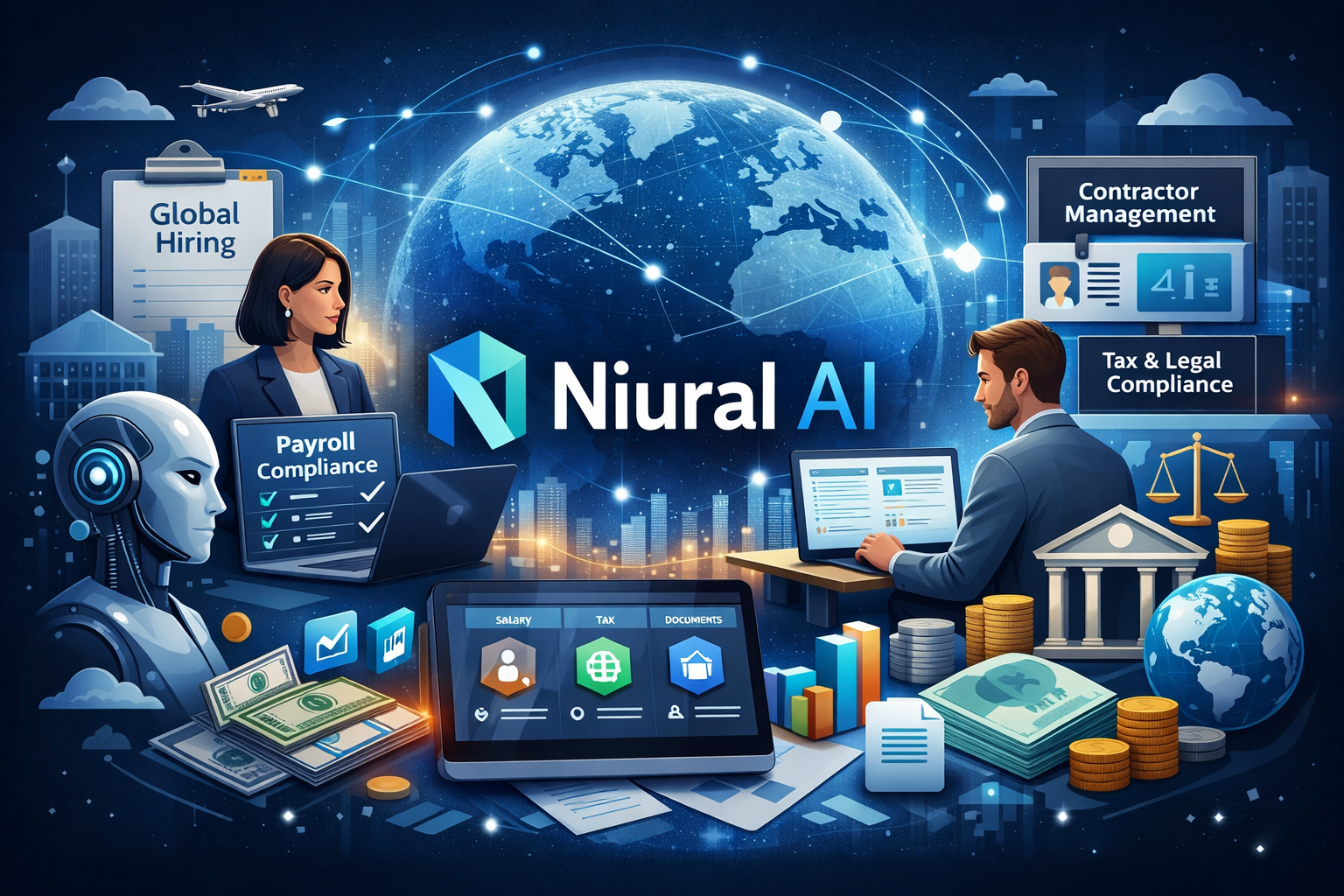
Niural AI sits within this category of emerging systems that combine financial infrastructure with automation and machine learning capabilities. Rather than functioning as a standalone consumer application, it is generally understood as part of a broader ecosystem designed to support global employment operations, particularly in areas such as payroll processing, compliance alignment, and contractor management.
The rise of such tools reflects a broader industry need: organizations must manage increasing regulatory diversity while maintaining operational efficiency across borders.
Read More About Niural AI
What Is Niural AI?
Niural AI can be described as an AI-assisted financial operations and workforce management system designed to support global employment workflows. It is typically associated with platforms that handle payroll processing, compliance tracking, and contractor or employee lifecycle management across different jurisdictions.
In practical terms, Niural AI belongs to the category of enterprise-focused software that leverages automation to assist in:
- Interpreting regulatory requirements
- Standardizing payroll workflows
- Supporting cross-border employment structures
- Reducing manual administrative tasks in HR and finance operations
Rather than functioning as a general-purpose artificial intelligence tool, it is positioned within a specialized domain where structured financial data, employment law, and compliance rules intersect.
From a classification perspective, Niural AI aligns with several overlapping categories:
- Workforce management systems
- Payroll automation platforms
- Compliance intelligence tools
- AI-assisted financial infrastructure software
Its relevance is primarily tied to organizations operating in multi-country environments where legal and financial obligations vary significantly.
Key Features Explained
Although implementations may differ depending on organizational use, tools in this category—including Niural AI—typically revolve around a set of core functional capabilities.
1. Automated Payroll Processing Support
One of the primary functions is the facilitation of payroll workflows across different jurisdictions. This involves:
- Structuring salary calculations based on regional rules
- Assisting with currency conversions and payment scheduling
- Supporting tax-related deductions according to local frameworks
The AI component is often used to reduce inconsistencies in recurring payroll cycles.
2. Compliance Monitoring and Rule Interpretation
Employment laws vary widely across countries, and maintaining compliance requires continuous updates. Systems like Niural AI may assist in:
- Interpreting regulatory changes
- Mapping workforce classifications to legal categories
- Identifying potential compliance gaps in workforce setups
This is especially relevant in regions with rapidly changing labor laws or complex contractor regulations.
3. Workforce Classification Assistance
A recurring challenge in global hiring is determining whether an individual should be classified as an employee or contractor. AI-driven systems may help analyze:
- Contract structures
- Work arrangements
- Jurisdiction-specific classification rules
This function reduces reliance on manual legal interpretation, though final decisions typically remain with human administrators.
4. Data Consolidation Across Regions
Global organizations often manage fragmented systems across multiple countries. Niural AI-type platforms tend to consolidate:
- Payroll records
- Tax documentation
- Employment contracts
- Payment histories
This centralization improves visibility across distributed teams.
5. Workflow Automation for Finance Teams
Automation capabilities often extend to repetitive administrative processes such as:
- Invoice handling
- Payment approvals
- Expense categorization
- Reporting generation
These features reduce operational overhead for finance departments.
Common Use Cases
The application of Niural AI is generally tied to organizations with distributed or international workforces. Typical use cases include:
Global Hiring Operations
Companies hiring employees in multiple countries use such systems to manage payroll and compliance requirements without establishing separate local infrastructures.
Remote Workforce Management
Organizations with fully remote teams rely on centralized systems to coordinate payments, contracts, and tax obligations across different regions.
Contractor Management
Businesses engaging freelancers or independent contractors use AI-supported platforms to handle classification, documentation, and payment workflows.
Finance and HR Coordination
Cross-functional teams in HR and finance departments utilize these systems to reduce duplication of work and maintain consistent employment records.
Regulatory Alignment for Expansion
Companies entering new markets often require tools that help interpret local employment regulations and operational constraints.
Potential Advantages
The adoption of AI-assisted workforce platforms like Niural AI is associated with several operational advantages in enterprise environments.
Operational Consistency
Standardized workflows reduce discrepancies in payroll execution and documentation handling across regions.
Reduced Manual Workload
Automation decreases the need for repetitive administrative tasks, particularly in payroll and compliance tracking.
Improved Data Organization
Centralized systems help maintain structured records across multiple jurisdictions, improving audit readiness.
Faster Decision Support
AI-based interpretation of regulatory frameworks can accelerate decision-making in workforce classification and onboarding processes.
Scalability for Distributed Teams
Such platforms are designed to support organizational growth without requiring proportional increases in administrative staffing.
Limitations & Considerations
Despite their capabilities, systems like Niural AI operate within certain constraints.
Dependence on Data Accuracy
AI outputs are heavily influenced by the quality and completeness of input data. Inaccurate records can lead to flawed interpretations.
Jurisdictional Complexity
Employment laws differ significantly across regions, and no automated system can fully eliminate the need for human legal oversight.
Implementation Overhead
Integrating such platforms into existing enterprise systems may require operational restructuring and training.
Limited Contextual Judgment
AI systems may struggle with nuanced employment scenarios that require subjective interpretation or negotiation.
Regulatory Evolution
Frequent changes in labor laws may require constant system updates and human validation.
Who Should Consider Niural AI Category
Niural AI-type systems are generally relevant for organizations with specific operational characteristics:
- Companies employing international or distributed teams
- Businesses managing large contractor networks
- Organizations expanding into multiple legal jurisdictions
- Enterprises requiring centralized payroll and compliance systems
- Finance and HR departments handling high-volume employment data
These systems are most applicable where operational complexity justifies automation investment.
Who May Want to Avoid It
Not all organizations benefit equally from AI-based workforce management platforms.
Small Local Businesses
Companies operating within a single jurisdiction with simple payroll structures may find such systems unnecessary.
Low-Volume Hiring Environments
Organizations with minimal hiring activity may not require centralized automation infrastructure.
Highly Specialized Legal Structures
Certain industries with unique regulatory frameworks may still rely heavily on manual legal processes.
Early-Stage Startups Without International Expansion
Businesses without cross-border operations may not fully utilize the capabilities of global compliance systems.
Comparison With Similar Niural AI
Niural AI belongs to a broader ecosystem of workforce and payroll management platforms. Comparable categories include:
Traditional Payroll Systems
These focus primarily on salary processing within a single jurisdiction and often lack advanced compliance intelligence features.
Global Employment Platforms
These systems handle international hiring, contractor management, and compliance but may vary in the level of AI integration.
HR Information Systems (HRIS)
HRIS platforms manage employee records and workflows but may not specialize in cross-border payroll or legal interpretation.
Fintech-Enabled Workforce Platforms
These combine financial infrastructure with workforce management, often incorporating automation and AI features similar to Niural AI.
The key differentiator for AI-enhanced systems is their attempt to reduce manual interpretation of regulatory and payroll complexity through automated reasoning layers.
Final Educational Summary
Niural AI represents a category of enterprise technology positioned at the intersection of artificial intelligence, workforce management, and financial operations. Its role is primarily functional rather than conceptual, focusing on supporting structured administrative processes in environments where employment spans multiple jurisdictions.
The broader significance of such systems lies in their response to evolving labor patterns. As organizations continue to decentralize and expand globally, the demand for tools that can handle compliance complexity and payroll coordination increases accordingly.
However, despite advances in automation, these systems remain dependent on human oversight, particularly in legal interpretation and contextual employment decisions. AI serves as an augmentation layer rather than a complete replacement for regulatory expertise.
In summary, Niural AI can be understood as part of a larger shift toward AI-supported enterprise infrastructure, where efficiency, consistency, and scalability are central design goals within global workforce management systems.
Explore Niural AI Now
