
Introduction
The expansion of digital communication has created an environment where public conversations influence perception, reputation, and decision-making at scale. Individuals routinely express opinions, share experiences, and evaluate products across a wide range of online platforms. These interactions form a continuous stream of unstructured data.
For organizations and researchers, the challenge lies not in the absence of information but in its fragmentation. Conversations occur simultaneously across social networks, blogs, news outlets, and forums, making it difficult to observe patterns without systematic tools. This challenge has led to the development of social listening systems—technologies designed to capture and organize dispersed online discussions into analyzable datasets.
Brand24 operates within this category. Its function is to collect publicly available mentions, structure them into coherent formats, and provide a basis for interpreting how digital discourse evolves.
What Is Brand24?
Brand24 is a social listening and media monitoring platform designed to track keyword-based mentions across various online sources. It belongs to a class of tools that focus on aggregating publicly accessible digital conversations and presenting them in a centralized interface.
The platform monitors:
- Social media platforms
- Online news publications
- Blogs and independent websites
- Community forums and discussion boards
Rather than functioning solely as a data collection mechanism, Brand24 organizes this information into structured outputs. These outputs enable users to identify patterns, assess visibility, and examine how topics develop over time.
In essence, Brand24 acts as an intermediary layer between raw online discourse and structured analytical observation.
Key Features Explained
Real-Time Mention Detection
Brand24 continuously scans selected sources for predefined keywords. When a relevant mention appears, it is recorded and displayed within the system without significant delay. This real-time capability allows users to observe developments as they occur.
Automated Sentiment Classification
The platform includes a sentiment analysis component that categorizes mentions into positive, negative, or neutral groups. This classification relies on language-processing models that evaluate tone and contextual indicators.
While not infallible, this feature provides a broad overview of how audiences perceive a subject.
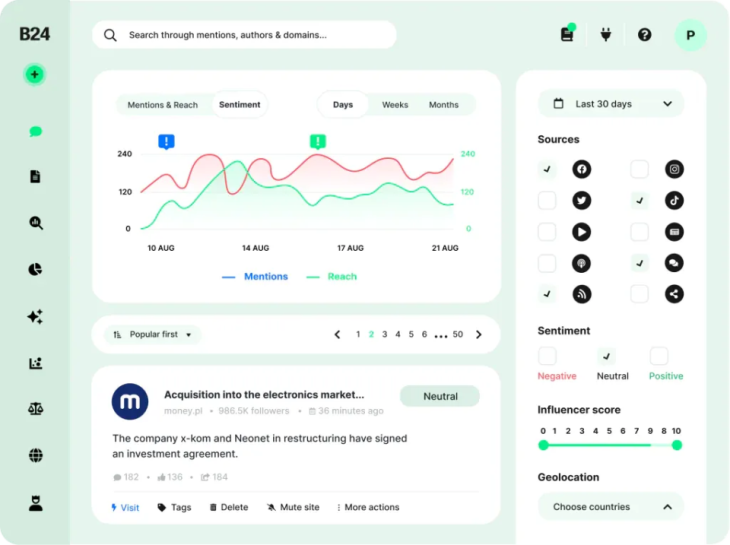
Data Structuring and Visualization
Large datasets are transformed into visual formats such as:
- Time-based mention graphs
- Source distribution summaries
- Engagement and reach estimations
These visualizations help simplify complex datasets and support pattern recognition.
Influencer and Source Identification
Brand24 identifies sources that contribute significantly to conversation reach. These sources may include accounts or domains with higher visibility or engagement levels.
Understanding which entities amplify discussions can be useful in mapping information flow.
Filtering and Segmentation Capabilities
To improve relevance, the platform allows segmentation based on:
- Keywords or phrases
- Language selection
- Source categories
- Sentiment groupings
Filtering reduces informational noise and enables focused analysis.
Alert Configuration
Users can define conditions under which notifications are triggered. These alerts may relate to sudden increases in mentions, specific keywords, or changes in sentiment patterns.
This functionality supports awareness without requiring continuous manual observation.
Common Use Cases
Monitoring Public Mentions
Organizations often use Brand24 to track references to their name, products, or related topics. This provides visibility into how they are discussed across different platforms.
Observing Market Conversations
Public discussions frequently reveal emerging needs, preferences, or concerns. By examining these conversations, users can identify recurring themes within a specific industry.
Evaluating Perception Trends
Changes in sentiment over time can indicate shifts in audience perception. Monitoring these changes helps contextualize reactions to events or announcements.
Assessing Communication Impact
Brand24 can be used to analyze how audiences respond to campaigns, announcements, or public statements by examining mention frequency and engagement patterns.
Competitor Observation
Tracking mentions associated with other entities in the same space provides comparative insight into visibility and audience response.
Potential Advantages
Consolidated Data Environment
Brand24 aggregates information from multiple sources into a single interface, reducing the need for manual cross-platform searches.
Efficiency in Data Collection
Automated tracking minimizes the time required to gather and organize information, allowing users to focus on interpretation.
Scalable Observation
The platform enables the analysis of large volumes of data that would be impractical to process manually.
Structured Insight Delivery
By organizing mentions into categories and visual formats, Brand24 supports clearer understanding of complex datasets.
Accessibility Across Skill Levels
The interface is designed for usability without requiring advanced analytical or technical expertise.
Limitations & Considerations
Incomplete Data Coverage
No social listening system can capture all online conversations. Access limitations and private discussions remain outside its scope.
Sentiment Interpretation Challenges
Automated classification may misinterpret tone, particularly in cases involving sarcasm, cultural nuance, or ambiguous language.
Dependence on Keyword Configuration
The relevance of collected data depends heavily on the accuracy of selected keywords. Poor configuration may lead to irrelevant or missing information.
Volume Management
High volumes of mentions can create analytical complexity if not managed through effective filtering.
Need for Human Interpretation
While the platform structures data, deriving meaningful conclusions requires contextual understanding and critical evaluation.
Who Should Consider Brand24
Brand24 may be appropriate for:
- Marketing and communication teams studying audience perception
- Researchers analyzing digital communication trends
- Organizations monitoring public visibility across platforms
- Agencies managing multiple clients or projects
- Analysts seeking structured datasets from online discourse
Its relevance increases in contexts where public conversation significantly influences outcomes.
Who May Want to Avoid It
The platform may be less suitable for:
- Use cases that do not rely on online visibility
- Situations requiring access to private or restricted data
- Individuals seeking highly specialized analytical systems beyond social listening
- Small-scale needs where manual monitoring is sufficient
In such scenarios, the platform’s capabilities may exceed practical requirements.
Comparison With Similar Tools
Brand24 operates within a competitive category that includes multiple social listening platforms. Differences among these tools typically involve:
- Depth of analytics and reporting features
- Breadth of data source coverage
- Interface complexity and usability
- Customization options
- Integration capabilities
Some alternatives focus on enterprise-level data processing and advanced integrations, while others emphasize simplicity and ease of use. Brand24 generally occupies a middle position, balancing structured insights with accessible functionality.
The suitability of any platform depends on the specific analytical requirements and operational scale.
Final Educational Summary
The increasing volume of online communication has made it necessary to develop systems capable of organizing and interpreting dispersed conversations. Social listening platforms address this need by transforming unstructured data into analyzable formats.
Brand24 exemplifies this approach by combining real-time tracking, sentiment classification, and data visualization. It enables users to observe how discussions evolve, identify patterns, and contextualize audience behavior.
At the same time, its effectiveness depends on thoughtful configuration and careful interpretation. As with any analytical system, it serves as a tool for observation rather than a substitute for critical analysis.
