
Introduction
Power interruptions and extreme weather events highlight a central problem for households and remote users: maintaining access to electricity when standard grid infrastructure fails. Traditional backup solutions often involve fuel‑powered generators, which can be noisy, require fuel storage, and emit exhaust. Solar‑based battery systems have emerged as alternatives that store electrical energy and can operate independently of conventional fuel sources. This article explains one such system — commonly referred to as the Grid Doctor 3300 framework and, in extended form, the Power Tower configuration — and explores how it functions, who might find it relevant, and what considerations apply.
What Is the Grid Doctor 3300 Power Tower?
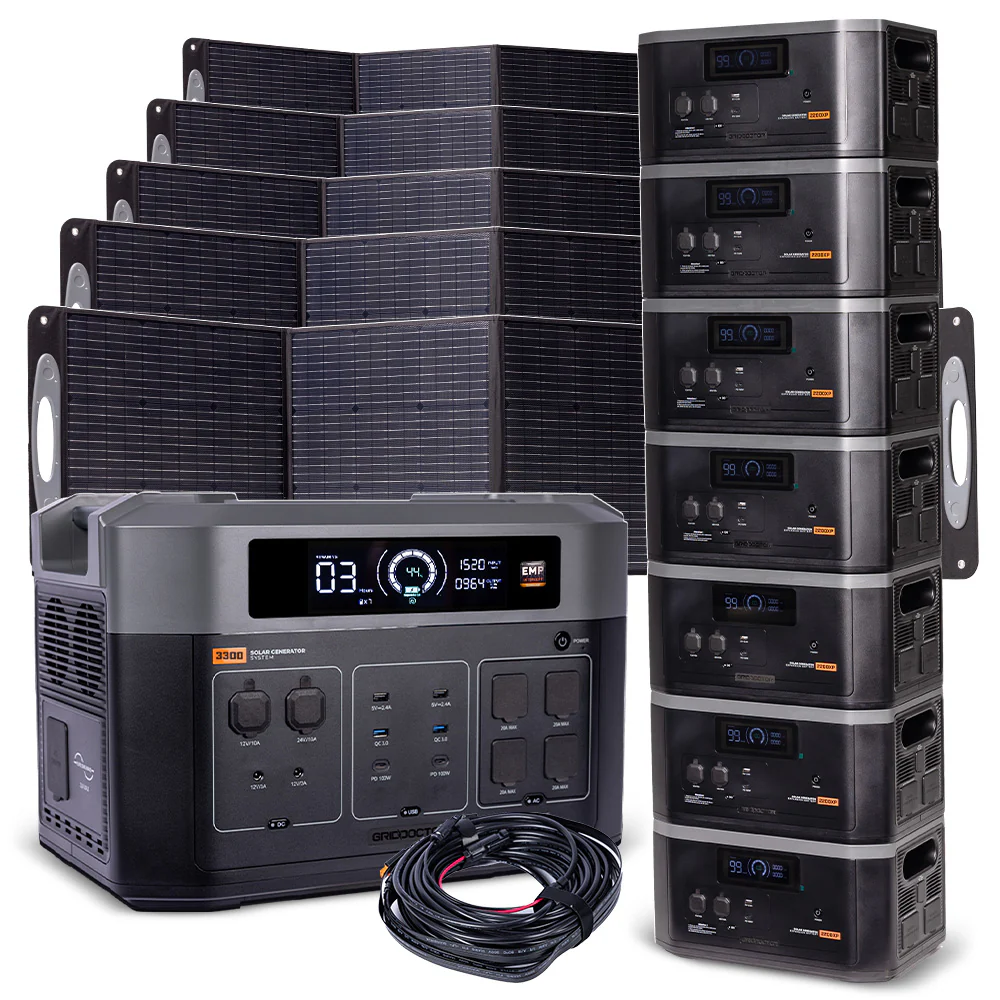
The term “Grid Doctor 3300 Power Tower” refers to a modular backup electrical power system based around a central solar generator component (the Grid Doctor 3300) and an array of expansion batteries.
This system belongs to a category of solar‑charged battery backup units designed to store electrical energy from solar panels or other charging methods (AC wall outlets or vehicle adapters). These systems aim to offer extended electrical supply during outages or in off‑grid environments, using stored DC power converted to usable AC output through built‑in inverters.
Users of such systems typically include homeowners in areas prone to outages, people preparing for extended grid failures, RV or remote site occupants, and others seeking portable energy storage without ongoing fuel dependency.
Key Features Explained
Central Power Module (3300)
The core generator unit typically features a lithium iron phosphate (LiFePO₄) battery with a capacity in the low‑thousands of watt‑hours and an inverter capable of continuous output measured in the low thousands of watts.
- Battery Type and Capacity: Uses LiFePO₄ cells, known for stable chemistry and multiple charge cycles.
- Output Ports: Standard AC outlets, USB‑A/C connectors, and other DC outputs for varied device compatibility.
- Inverter Rating: Designed to provide continuous AC output suitable for many household devices and tools.
- Charging Options: Solar panel input, AC mains, or vehicle port charging are common methods.
Expandable Battery Modules
Up to several expansion batteries may be connected beneath the main unit to increase total energy storage. When stacked, this configuration is sometimes labelled a “Power Tower,” reflecting the larger aggregate capacity.
Solar Integration
Solar panels included in many system bundles allow for energy harvesting from sunlight, with stacking or multiple panels increasing input potential.
Management Features
Some systems include power management that balances charging and discharge across connected battery modules, as well as pass‑through charging that allows use while recharging.
Common Use Cases
Solar‑based backup systems serve in situations where sustained power availability matters:
- Emergency Preparedness: Supporting lights, communications, refrigeration, and medical devices during grid outages.
- Remote Living or Travel: Serving as an off‑grid supply for cabins, campsites, or recreational vehicles.
- Critical Device Support: Short‑term operation of essential devices where uninterrupted supply is desirable.
- Supplemental Usage: Reducing reliance on main grid power for certain applications or tasks.
These scenarios emphasize redundant and portable energy rather than long‑term whole‑house supply.
Potential Advantages
Potential advantages of this type of system may include:
- Fuel‑Free Operation: Uses stored electrical energy with optional solar recharging, reducing dependence on liquid fuels.
- Indoor‑Safe Usage: Unlike fuel generators, electrical battery systems produce no combustion exhaust.
- Portability: Designed to be moved and deployed where needed, without complex installation.
- Modularity: Capacity can be increased through additional battery units.
These factors are contextual; whether they matter depends on the user’s environment and needs.
Limitations & Considerations
Technical and practical limitations may include:
- Upfront Cost: High initial outlay relative to simple battery packs or basic generators.
- Weather Dependence for Solar: Solar charging rates vary with weather and day length.
- Capacity Constraints: A single unit may not sustain high continuous loads such as central HVAC without significant expansion.
- Charging Infrastructure: Charging from mains or vehicle ports requires compatible hardware and environment.
- Temperature Sensitivity: Performance and battery life can vary with environmental conditions.
These factors influence usability and should be matched to the specific scenario being planned for.
Who Should Consider This Product
This type of backup system may be appropriate for:
- Users in regions with frequent power outages seeking alternative energy storage.
- Individuals or groups engaged in outdoor or mobile activities requiring reliable supplemental power.
- Those wanting a safer, quieter backup than combustion‑based generators for indoor proximity.
Who May Want to Avoid It
It may be less suitable for:
- Households requiring whole‑house continuous power without modular scaling.
- Situations with very high continuous loads beyond the rated output.
- Users with tighter budgets prioritizing low initial cost over modular expandability.
Comparison With Similar Tools
Solar backup battery systems compete with:
- Fuel‑based generators: Provide high immediate power but require fuel and are noisier.
- Grid‑tied solar systems with battery storage: More permanent but typically involve installation complexity.
- Smaller portable batteries: Lower cost and weight but limited capacity.
Each category has trade‑offs around cost, capacity, complexity, and energy independence.
Final Educational Summary
Solar‑based battery backup systems such as the Grid Doctor 3300 framework aim to bridge gaps in power continuity during disruptions. They store electrical energy and can deliver it through multiple output options, with modular configurations allowing users to scale storage capacity. The choice of any backup system should be based on individual power needs, environmental conditions, and practical considerations rather than assumptions about performance. Readers should evaluate tools based on their own requirements and verify specifications with official product documentation.
Disclosure: This article is for educational and informational purposes only. Some links on this website may be affiliate links, but this does not influence our editorial content or evaluations.
