Introduction
Organizations increasingly rely on structured feedback to understand user behavior, customer satisfaction, and product performance. As digital interactions expand across websites, applications, and communication channels, collecting meaningful insights has become more complex. Traditional feedback methods—such as long-form email surveys or post-purchase questionnaires—often struggle with low response rates and delayed insights.
This gap has led to the rise of specialized survey and feedback tools designed to capture user sentiment in real time. These platforms aim to integrate directly into digital touchpoints, enabling organizations to gather contextual data without interrupting user experience. Within this broader category, tools like Survicate have emerged as notable solutions focused on continuous feedback collection and analysis.
What Is Survicate?
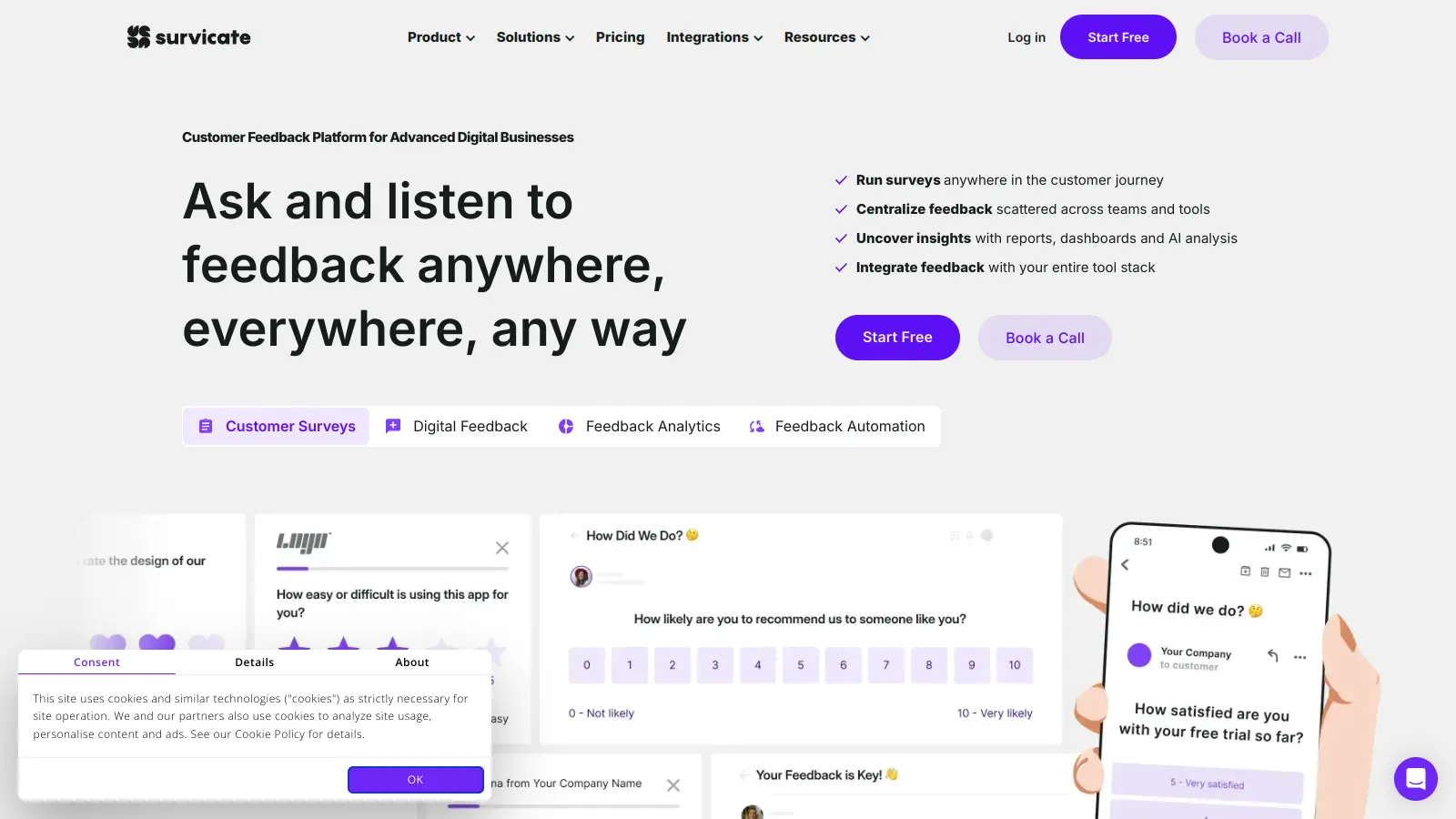
Survicate is a customer feedback and survey platform designed to help organizations collect insights across multiple channels, including websites, mobile apps, email campaigns, and in-product experiences. It falls within the category of customer experience (CX) software and survey automation tools, often used by marketing, product, and customer success teams.
The platform allows users to design surveys, distribute them through various touchpoints, and analyze responses in a centralized environment. Its core function is to provide a structured way to gather qualitative and quantitative data from users at different stages of their journey.
Unlike standalone survey tools that operate independently, Survicate emphasizes integration with other systems such as customer relationship management (CRM) platforms, marketing automation tools, and analytics software. This integration enables organizations to connect feedback data with user behavior and operational metrics.
Key Features Explained
Multi-Channel Survey Distribution
One of the defining characteristics of Survicate is its ability to deploy surveys across multiple environments. Surveys can be embedded on websites, triggered within applications, or sent via email. This flexibility allows organizations to collect feedback at relevant moments, such as after a user completes a task or interacts with a feature.
Targeting and Triggering Mechanisms
The platform includes targeting options that determine when and to whom surveys are shown. These triggers may be based on user behavior, session duration, location, or specific actions taken within a digital interface. This approach helps ensure that feedback is collected in context rather than randomly.
Survey Design and Customization
Survicate provides tools for creating surveys with various question types, including multiple choice, open-ended, rating scales, and Net Promoter Score (NPS) formats. Customization options allow organizations to align surveys with their branding and user interface design.
Real-Time Data Collection and Reporting
Responses are collected and displayed in near real time, enabling teams to monitor feedback as it is submitted. Dashboards and reporting tools present aggregated data, trends, and individual responses, supporting both high-level analysis and detailed review.
Integration Capabilities
The platform integrates with a range of third-party tools, including analytics platforms, CRM systems, and communication tools. This allows feedback data to be combined with other datasets, supporting more comprehensive analysis.
Feedback Automation
Automation features enable users to set up recurring surveys, trigger follow-up questions, and route responses to specific teams. This reduces the need for manual intervention and supports continuous feedback loops.
Common Use Cases
Customer Experience Measurement
Organizations frequently use Survicate to measure customer satisfaction through metrics such as NPS, Customer Satisfaction Score (CSAT), and Customer Effort Score (CES). These metrics provide standardized ways to evaluate user sentiment over time.
Product Feedback Collection
Product teams use the platform to gather insights about feature usability, bugs, and user preferences. Surveys can be triggered after specific interactions, allowing teams to understand how users respond to changes or updates.
Website User Behavior Analysis
Website-based surveys help organizations understand why users behave in certain ways, such as abandoning a page or not completing a purchase. This qualitative data complements quantitative analytics tools.
Market Research
Survicate can also be used for broader research purposes, including gathering opinions about new concepts, testing messaging, or understanding audience demographics.
Customer Support Feedback
After interactions with support teams, surveys can be used to evaluate service quality and identify areas for improvement.
Potential Advantages
Contextual Feedback Collection
By embedding surveys directly into user journeys, Survicate enables organizations to collect feedback at relevant moments. This can lead to more accurate and detailed responses compared to delayed surveys.
Centralized Data Management
The platform consolidates feedback from multiple channels into a single interface. This simplifies data management and reduces fragmentation across different tools.
Scalability
Survicate is designed to handle feedback collection at various scales, from small teams to larger organizations. Automation features support ongoing data collection without requiring constant manual setup.
Integration with Existing Systems
The ability to connect with other tools allows organizations to incorporate feedback into broader workflows. For example, responses can be linked to customer profiles or used to trigger internal processes.
Flexibility in Survey Design
A wide range of question types and customization options supports different research needs, from simple satisfaction checks to more complex surveys.
Limitations & Considerations
Learning Curve
While the platform offers extensive features, new users may require time to understand its full capabilities. Setting up advanced targeting and integrations can be complex for those unfamiliar with similar tools.
Dependence on User Participation
As with any survey-based system, the quality of insights depends on response rates. If users choose not to engage with surveys, the data collected may be limited or biased.
Potential for Survey Fatigue
Frequent or poorly timed surveys can lead to user fatigue, reducing engagement and potentially affecting user experience. Careful planning is required to avoid over-surveying.
Integration Complexity
Although integrations are a strength, they may require technical knowledge or additional configuration. Organizations without dedicated technical resources may face challenges in fully utilizing these features.
Data Interpretation Challenges
Collecting feedback is only one part of the process. Interpreting qualitative responses and translating them into actionable insights can require additional analytical expertise.
Who Should Consider Survicate
Survicate may be relevant for:
- Product teams seeking direct user feedback on features and usability
- Marketing professionals interested in understanding customer sentiment and campaign effectiveness
- Customer experience (CX) specialists tracking satisfaction metrics across touchpoints
- SaaS companies aiming to integrate feedback into digital products
- Research teams conducting ongoing user or market analysis
Organizations that prioritize continuous feedback and data-driven decision-making may find tools in this category aligned with their workflows.
Who May Want to Avoid It
This type of platform may be less suitable for:
- Organizations with minimal digital presence, where survey distribution channels are limited
- Teams seeking one-time survey solutions rather than ongoing feedback systems
- Users without resources for analysis, as interpreting feedback requires time and expertise
- Businesses concerned about user disruption, particularly if surveys are not carefully implemented
In such cases, simpler survey tools or alternative research methods may be more appropriate.
Comparison With Similar Tools
Survicate operates within a competitive landscape that includes other survey and feedback platforms such as Typeform, SurveyMonkey, and Qualtrics.
Typeform is known for its conversational survey design and user-friendly interface, often used for engaging form experiences. However, it may focus more on design than on deep integration with product workflows.
SurveyMonkey offers a broad range of survey templates and distribution options, making it suitable for general-purpose surveys. Its strength lies in accessibility and widespread adoption.
Qualtrics, on the other hand, provides enterprise-level experience management solutions with advanced analytics and research capabilities. It is often used by large organizations with complex data requirements.
Compared to these tools, Survicate emphasizes in-product and contextual feedback collection, along with integration into existing digital ecosystems. Its positioning reflects a focus on continuous, real-time insights rather than standalone survey campaigns.
Final Educational Summary
Survey-based feedback tools have become an essential component of modern digital strategies, enabling organizations to capture user insights in real time. Within this category, Survicate represents a platform designed to integrate feedback collection directly into user experiences across multiple channels.
Its features—ranging from targeted survey deployment to real-time reporting—support a structured approach to understanding customer behavior and sentiment. At the same time, considerations such as survey fatigue, data interpretation, and integration complexity highlight the importance of thoughtful implementation.
For organizations seeking to align feedback with product development, marketing strategies, and customer experience initiatives, tools like Survicate offer a framework for continuous insight gathering. However, the effectiveness of such platforms ultimately depends on how well they are integrated into broader workflows and decision-making processes.
Disclosure: This article is for educational and informational purposes only. Some links on this website may be affiliate links, but this does not influence our editorial content or evaluations.