
Introduction
The rapid expansion of artificial intelligence tools has created a new category of software platforms designed to help individuals and organizations build automated workflows powered by large language models. As AI models become more capable of generating text, analyzing information, and assisting with decision-making, the challenge has shifted from accessing AI itself to organizing it into structured, repeatable systems.
Many teams encounter practical barriers when attempting to integrate AI into everyday processes. These barriers include technical complexity, fragmented tools, and the need for coding knowledge to create structured AI-driven workflows. As a result, a class of platforms has emerged to simplify the creation of AI-powered applications, assistants, and automated processes.
Platforms in this category often provide visual interfaces, prompt management systems, and workflow orchestration tools that enable users to design AI-driven tasks without extensive programming. One such platform is MindStudio, which focuses on building AI workers and structured workflows using large language models and automation tools.
Understanding how platforms like MindStudio function requires examining the broader ecosystem of AI workflow builders, their capabilities, and their potential limitations.
What Is MindStudio?
MindStudio is a platform designed for building AI-powered workflows and digital workers using large language models and automation frameworks. It belongs to the category of AI workflow automation platforms and AI agent development tools.
The platform enables users to design structured AI processes that can perform tasks such as research assistance, data analysis, document generation, and multi-step reasoning. Instead of interacting with AI models through a simple chat interface, MindStudio focuses on constructing reusable systems where AI performs predefined tasks within a workflow.
MindStudio typically operates through a visual or modular design environment where users can assemble components such as prompts, data inputs, conditional logic, and external integrations. These components form workflows that guide how the AI processes information and generates outputs.
In this sense, MindStudio can be viewed as a bridge between conversational AI tools and traditional automation platforms. Rather than relying on one-off prompts, it allows users to design structured AI applications that perform consistent tasks repeatedly.
Platforms like MindStudio are often used by developers, researchers, analysts, and operational teams seeking to organize AI capabilities into scalable processes.
Key Features Explained
AI Workflow Builder
One of the central features of MindStudio is its workflow construction system. Instead of issuing a single prompt to an AI model, users can design multi-step processes where different tasks are handled sequentially.
For example, a workflow may involve:
- Collecting input data
- Running an AI analysis step
- Filtering or restructuring information
- Generating a formatted report
This approach supports repeatable processes where AI contributes to structured decision-making or document generation.
Prompt Engineering Framework
MindStudio includes tools that allow users to design and manage prompts systematically. Prompt engineering plays a critical role in determining how language models interpret tasks and produce outputs.
The platform enables prompts to be reused across workflows, edited centrally, and refined as performance improves. This structure can be useful in environments where multiple tasks rely on similar instructions or formatting requirements.
AI Workers and Agents
Another concept associated with MindStudio is the creation of AI workers or AI agents. These are automated systems configured to perform specific tasks using predefined instructions and datasets.
Examples of AI workers may include:
- Research assistants that summarize documents
- Content analysis tools that categorize text
- Data interpreters that extract insights from reports
Rather than functioning as general-purpose chatbots, these agents are designed to execute defined responsibilities within a workflow.
Data Integration Capabilities
AI workflows often require interaction with external information sources. MindStudio supports structured data inputs that allow AI models to process:
- Uploaded documents
- Structured datasets
- Knowledge bases
- User-provided text inputs
These integrations enable workflows that analyze real-world information rather than relying only on conversational input.
Conditional Logic and Workflow Control
MindStudio workflows can include decision points that determine how tasks proceed. Conditional logic allows the system to route information differently depending on the content being processed.
For instance, a workflow may:
- Continue to a deeper analysis if a certain keyword appears
- Generate different reports based on classification results
- Trigger additional tasks when certain conditions are met
This capability helps create more flexible AI-driven automation systems.
Output Formatting and Reporting
Many AI workflows ultimately produce structured outputs such as reports, summaries, or formatted documents. MindStudio allows users to define how these outputs should appear.
Examples include:
- Structured summaries
- Bullet-point reports
- Data tables
- formatted text outputs
This formatting step is important for organizations that require standardized documentation.
Common Use Cases
AI-Assisted Research
Researchers and analysts often use AI workflow tools to process large volumes of information. MindStudio workflows can assist with summarizing research papers, extracting key findings, or organizing datasets.
Instead of manually reviewing large text collections, AI can identify patterns or highlight relevant insights.
Content Analysis and Categorization
Organizations working with large amounts of textual content may use AI workflows to classify or evaluate documents. MindStudio can be configured to categorize customer feedback, analyze reports, or group information into themes.
Such processes are often used in fields such as market research and customer experience analysis.
Document Generation
AI workflow systems can also assist in generating structured documents. For example, workflows may transform raw data into reports, summaries, or knowledge briefs.
This approach can be helpful when repetitive document preparation tasks occur frequently.
Business Process Automation
Some teams explore AI workflow platforms as part of broader automation strategies. MindStudio can be configured to support tasks such as:
- Drafting internal summaries
- Organizing meeting notes
- Creating structured analyses from raw inputs
In these cases, AI functions as a supporting tool rather than replacing human review.
Educational and Knowledge Tools
Educational organizations and training programs sometimes experiment with AI workflows for knowledge extraction and content structuring.
Examples include:
- Generating study summaries
- Organizing lecture materials
- Structuring research notes
These systems can assist with information management rather than replacing academic evaluation.
Potential Advantages
Structured AI Usage
A key advantage of platforms like MindStudio is their ability to organize AI capabilities into structured workflows. This can reduce reliance on ad-hoc prompts and make AI outputs more predictable.
Reduced Technical Barriers
Many AI development tools require programming knowledge. MindStudio’s modular design approach may lower the technical barrier for users who want to experiment with AI automation without building full software applications.
Reusable AI Processes
Once workflows are created, they can often be reused multiple times. This helps standardize tasks that would otherwise require repeated manual prompting.
Consistency in Output
Workflow systems can help ensure outputs follow predefined formats. This can be useful in environments where documentation or reporting needs to follow specific structures.
Integration With Organizational Data
By combining AI models with structured data inputs, platforms like MindStudio enable workflows that analyze real information rather than hypothetical examples.
Limitations & Considerations
Dependence on AI Model Quality
AI workflow platforms ultimately rely on underlying language models. If the model produces inaccurate or incomplete information, the workflow output may also be affected.
Human oversight remains necessary when interpreting AI-generated results.
Workflow Design Complexity
Although visual workflow builders reduce coding requirements, designing effective AI processes still requires thoughtful planning. Poorly structured workflows can lead to inconsistent or irrelevant outputs.
Data Privacy Concerns
Organizations working with sensitive information must evaluate how data is processed and stored within AI platforms. Privacy policies, data handling practices, and compliance requirements should be reviewed carefully.
Learning Curve
While some AI workflow platforms aim to simplify development, users may still need time to understand prompt design, workflow logic, and output evaluation.
Limited Context Understanding
Even advanced AI models have limitations in reasoning and factual accuracy. Automated workflows may occasionally generate incomplete interpretations of complex information.
Who Should Consider MindStudio
MindStudio may be relevant for individuals and teams exploring structured AI automation.
Potential users include:
- Researchers managing large text datasets
- Analysts building AI-assisted reporting tools
- Developers experimenting with AI agent frameworks
- Operations teams exploring workflow automation
- Educational institutions studying AI-assisted knowledge management
These users typically benefit from structured environments where AI tasks can be organized and repeated.
Who May Want to Avoid It
Some users may find AI workflow platforms unnecessary depending on their needs.
Examples include:
- Individuals who only require simple AI chat tools
- Organizations without defined AI use cases
- Teams lacking time to design and test workflows
- Users who prefer direct programming environments
For basic tasks such as occasional text generation, simpler AI interfaces may be sufficient.
Comparison With Similar Tools
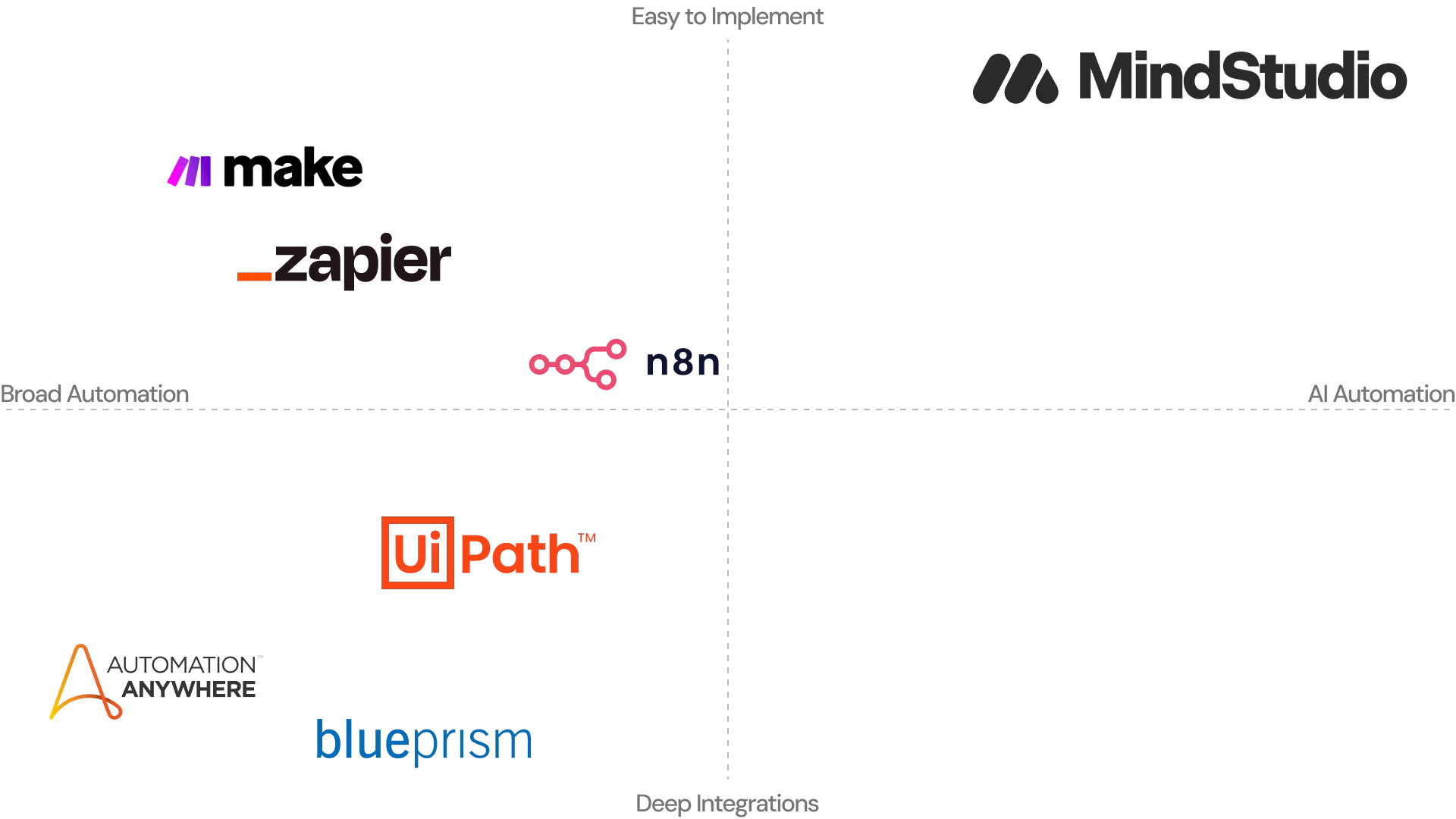
MindStudio operates within a growing ecosystem of AI development and workflow tools. Several platforms provide comparable capabilities, though their design philosophies differ.
Some tools focus on AI agent development, allowing developers to construct autonomous systems that interact with external APIs. Others emphasize no-code automation, making it easier for non-technical users to create workflows.
Compared with general-purpose AI chat tools, MindStudio emphasizes structured automation rather than conversational interaction. Workflows are designed to perform defined tasks rather than open-ended dialogue.
In contrast to traditional automation platforms, AI workflow builders integrate language models directly into decision-making processes. This allows tasks involving text interpretation, summarization, and reasoning to be automated.
The choice between platforms often depends on technical requirements, integration needs, and the complexity of workflows being developed.
Final Educational Summary
MindStudio represents a category of software platforms designed to organize artificial intelligence capabilities into structured workflows and automated agents. Instead of relying solely on conversational prompts, it allows users to design repeatable systems where AI performs specific tasks within defined processes.
The platform includes features such as workflow builders, prompt management systems, AI worker creation tools, and structured data integration capabilities. These features support use cases ranging from research analysis and document generation to knowledge management and operational automation.
At the same time, platforms like MindStudio require careful workflow design and ongoing human oversight. AI-generated outputs can contain inaccuracies, and automated processes must be evaluated regularly to ensure they function as intended.
As AI adoption continues to expand across industries, workflow-oriented platforms represent an evolving approach to organizing and applying language model capabilities in structured environments.
Disclosure: This article is for educational and informational purposes only. Some links on this website may be affiliate links, but this does not influence our editorial content or evaluations.
